

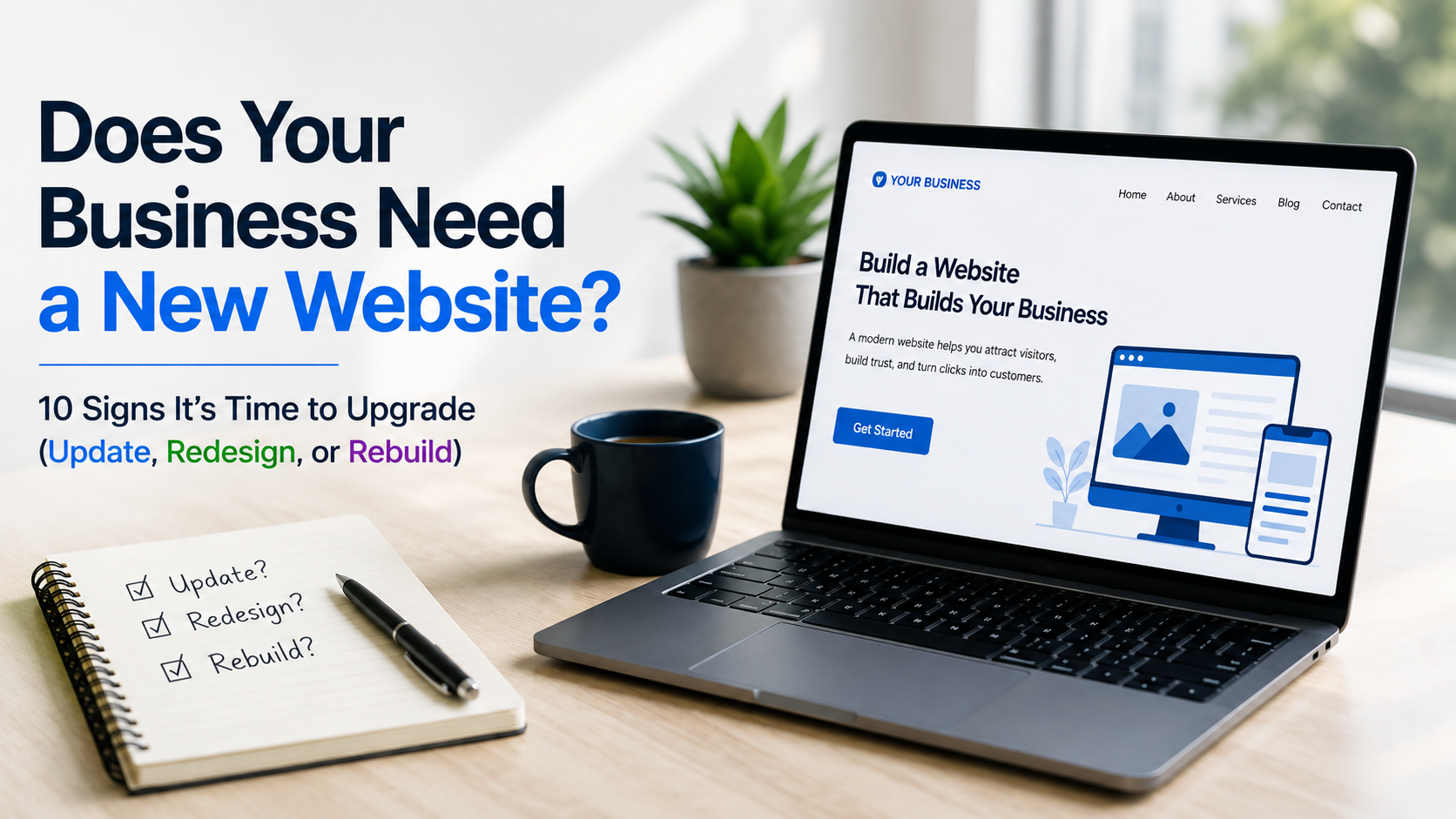
Does Your Business Need a New Website? 10 Signs It’s Time for an Upgrade
Your website might still be working.
It opens when someone visits it. The pages are there. Your phone number is visible. Maybe people can even fill out a contact form.
But that doesn’t always mean your website is helping your business.
Think about it this way.
An old car may still start and take you from one place to another. But if it breaks down often, uses too much fuel, and needs constant repairs, you eventually start asking whether it is worth keeping.
A website can be similar.
It may still work, but it could be:
- Slow
- Difficult to use on a phone
- Hard to update
- Confusing for visitors
- Poor at generating enquiries
- Outdated compared with your business today
- Unable to connect with the tools your business now uses
The question is not simply:
“Is my website old?”
The better question is:
“Is my website still helping my business grow?”
At Lebx, we work with businesses on websites, lead generation, and automation. That means we don’t only look at how a website looks. We also look at what happens when someone visits, submits a form, becomes a lead, or needs to move through your business process.
Sometimes a business only needs a few improvements.
Sometimes it needs a redesign.
And sometimes, the existing website has so many problems that rebuilding it makes more sense.
In this guide, we’ll help you understand the difference.
You can also explore the website development, lead generation, and automation services we provide at Lebx Services.
Start With This Simple Website Test
Before thinking about a new website, look at your current one in five areas.
1. Performance
Is your website fast and working properly?
2. User Experience
Can visitors easily find what they are looking for?
3. Trust
Does your website make your business look professional and credible?
4. Conversion
Does your website help turn visitors into calls, enquiries, bookings, or customers?
5. Growth
Can your website support your business as it grows?
For example, imagine your business adds three new services next year.
Can your current website easily support them?
What if you want to connect your website with a CRM or automate your lead follow-up?
If your website cannot support where your business is going, it may be time to make changes.
Now let’s look at the main warning signs.
1. Your Website No Longer Reflects Your Business
Businesses change over time.
Maybe you started with one service and now offer five.
Maybe you changed your target customers.
Maybe you hired a team.
Maybe your business has grown, but your website still looks like it belongs to a much smaller company.
This can confuse potential customers.
For example, imagine you now offer website development, automation, and lead generation, but your website only talks about one old service.
A visitor may leave without ever knowing everything you can actually help them with.
Ask yourself:
If someone visits my website for the first time today, will they understand what my business does?
They should quickly understand:
- What you offer
- Who you help
- Why they should choose you
- What they should do next
If your website doesn’t do this clearly, it needs attention.
Sometimes updating the content is enough.
But if your business has changed significantly, a complete redesign may make more sense.
2. Your Website Is Difficult to Use on Mobile
Many people will visit your website from their phone.
So don’t just check how your website looks on your computer.
Open it on your phone and test it yourself.
Try to:
- Find your services
- Read the important information
- Click the main buttons
- Fill out your contact form
- Call or message the business
Was it easy?
Common problems include:
- Text that is too small
- Buttons that are difficult to tap
- Pages that don’t fit properly
- Forms that are frustrating to fill out
- Important information that is difficult to find
- Slow-loading pages
For example, imagine a customer is searching for a local service while travelling or during a busy day.
They find your business on Google and visit your website.
If they have to zoom in, scroll around, and search for your phone number, there is a good chance they will leave.
A website should make the next step easy.
3. Your Website Is Slow
Nobody enjoys waiting for a website to load.
If your homepage takes too long, some visitors may leave before they even see what you offer.
But there is an important point here:
A slow website does not always mean you need a completely new website.
Sometimes the problem is easier to fix.
For example:
- Images may be too large
- Too many plugins may be installed
- The hosting may be poor
- Old scripts may be slowing the site down
- Unnecessary tools may be loading on every page
In these cases, improving the existing website may be enough.
However, if the website has deeper technical problems, outdated technology, and recurring performance issues, rebuilding may be the better long-term option.
This is why finding the actual problem matters before deciding what to do.
At Lebx, website development work is approached by looking at both the visible website and the technical side behind it.
Explore Lebx website and business services.
4. Visitors Can’t Find What They Need
A visitor should not have to work hard to understand your website.
Within a short time, they should know:
- What your business does
- Whether you can help them
- Where to find the information they need
- How to contact you
Imagine walking into a physical store where there are no signs.
You don’t know where anything is.
You have to ask someone for every small thing.
A confusing website can feel the same.
Common problems include:
- Too many menu options
- Important services hidden deep inside the website
- Confusing page names
- Too much information on one page
- No clear next step
Sometimes businesses keep adding new pages over several years without improving the overall structure.
Eventually, the website becomes messy.
Adding a new colour or changing the homepage may not solve this.
The real problem may be how the website is organised.
5. Your Website Gets Visitors but Not Enough Enquiries
Getting people to visit your website is only part of the job.
What happens after they arrive?
For example, imagine 1,000 people visit your website every month.
But only a few contact you.
The problem may not be traffic.
The problem may be that the website is not helping visitors take the next step.
Look for issues such as:
- Unclear messaging
- Weak calls to action
- No testimonials or proof
- Complicated contact forms
- No clear reason to choose your business
- Important information hidden too far down the page
For example, a visitor may be interested in your service but still leave because they are unsure about:
- Pricing
- What happens next
- Whether you serve their area
- Whether you have experience with businesses like theirs
A good website should answer important questions before the customer has to ask them.
It should also make the next step clear.
That could be:
- Get a quote
- Book a call
- Request a demo
- Contact us
- Start a project
The goal is not to force people to contact you.
The goal is to make it easy when they are ready.
For businesses looking to improve how their websites generate enquiries and support growth, Lebx provides services for websites, lead generation, and business growth.
6. Your Website Looks Less Trustworthy Than Your Competitors
This is not about copying every new website design trend.
You don’t need fancy animations everywhere.
You don’t need to redesign your website every year.
But you should understand what potential customers see when they compare you with other businesses.
Try this.
Search for your main service.
Open your website.
Then open three competitors.
Ask yourself:
- Which business is easiest to understand?
- Which website is easiest to use?
- Which one looks more professional?
- Which one makes it easiest to get in touch?
- Which one would you trust if you were a customer?
You may find that the problem isn’t that your website is “old.”
The problem may be that it does not clearly communicate the value of your business.
Trust can come from simple things:
- Clear information
- Real testimonials
- Good images
- Easy navigation
- Professional design
- Updated content
- Clear contact information
Your website does not need to be complicated to build trust.
Often, simpler is better.
7. Updating Your Website Has Become Difficult
Imagine you want to make a simple change.
Maybe you need to:
- Add a new service
- Change your phone number
- Update a price
- Add a new team member
- Publish a blog post
How easy is it?
If every small change requires contacting a developer, waiting several days, or worrying that something will break, your website may no longer be working well for your business.
Your website should not create unnecessary work.
As your business grows, you will probably need to update things more often.
A website that is difficult to manage can slow down your marketing and create frustration for your team.
This doesn’t always mean the entire website needs rebuilding.
But it is an important problem to consider.
8. Your Website Keeps Having Technical Problems
Every website can have occasional problems.
But recurring problems are different.
For example:
- Contact forms stop working
- Plugins conflict with each other
- Pages break after updates
- Security problems appear
- Important features stop working
- Parts of the website are no longer supported
At some point, you need to ask:
Are we fixing the same website again and again instead of fixing the real problem?
Think of it like repairing an old machine.
One repair may be worth it.
But if something new breaks every month, continuing to repair it may eventually cost more than replacing it.
The same idea can apply to a website.
Before rebuilding, it is important to understand what is actually causing the problems.
But if the website has outdated technology and constant technical issues, starting with a better structure may be the smarter option.
9. Your Website Doesn’t Work Well With the Tools Your Business Uses
Today, a website can do much more than display information.
It can connect with the systems your business already uses.
For example:
- CRM software
- Booking tools
- Email platforms
- Payment systems
- Customer support tools
- Analytics
- Lead management systems
Here is a simple example.
A potential customer fills out a form on your website.
What happens next?
Without a good system:
- The enquiry arrives in an inbox.
- Someone notices it later.
- They manually copy the information into another system.
- Someone decides who should contact the lead.
- The follow-up happens manually.
With the right setup:
- The visitor submits the form.
- The information is automatically sent to the right system.
- The correct team member is notified.
- The customer receives a confirmation.
- A follow-up process can start automatically.
This is where websites and automation can work together.
The website becomes more than an online brochure.
It becomes part of how your business operates.
At Lebx, we work on this type of connection between websites, business systems, lead generation, and automation.
Explore Lebx automation and business services.
10. Your Business Has Outgrown Your Website
Your website may have been perfect when it was first created.
But businesses grow.
Maybe you started with one location and now have several.
Maybe you added more services.
Maybe your customers have changed.
Maybe you now need your website to support lead generation, automation, or new tools.
The website that worked for you three or five years ago may no longer be suitable.
For example, imagine building a small shop.
Later, your business grows, and you need more space, storage, and new systems.
You could keep adding things wherever there is room.
Or you could redesign the space properly.
A website can reach the same point.
Adding more pages, plugins, and temporary fixes may eventually make it harder to manage.
That is when rebuilding from a clear plan can make more sense.
Do You Need a New Website, a Redesign, or Just Some Improvements?
Not every problem requires a completely new website.
This is where many businesses make the wrong decision.
They either spend too much rebuilding something that could have been improved or keep patching a website that needs a complete rethink.
Here is a simple way to decide.
You May Only Need Improvements If:
Your website:
- Has a good structure
- Is technically reliable
- Mainly has outdated content
- Has some design issues
- Has fixable speed problems
- Is still easy for visitors to use
You may only need:
- Content updates
- Better images
- Design improvements
- Speed optimisation
- Improved calls to action
You May Need a Redesign If:
Your website:
- Has confusing navigation
- Does not clearly explain your business
- Has a poor mobile experience
- Has weak conversion paths
- No longer matches your brand
- Has a structure that no longer makes sense
In this case, the website may need a new design and better structure while keeping some of the existing technical setup.
You May Need a Complete Rebuild If:
Your website:
- Uses outdated technology
- Has recurring technical problems
- Is difficult to maintain
- Cannot support important tools or integrations
- Has widespread performance problems
- No longer fits your business
- Has been heavily patched over many years
A rebuild gives you a chance to start with a clear plan instead of continuing to fix old problems.
If you are unsure which option makes sense, explore Lebx services for website development, business growth, and automation.
Take the 2-Minute Website Test
Check each statement that applies to your business.
-
My website no longer accurately reflects my business.
-
It is difficult to use on a phone.
-
Important pages are slow.
-
Visitors may struggle to find information.
-
Our services or messaging are outdated.
-
We get visitors but not enough enquiries.
-
Updating the website is difficult.
-
We regularly experience technical problems.
-
Our competitors provide a better online experience.
-
Our business has changed significantly since the website was built.
Your Result
0–2 problems
Your website may only need a few targeted improvements.
Start by identifying the exact problems before thinking about a complete rebuild.
3–5 problems
Your website may need a more detailed review.
There could be problems with design, user experience, content, or conversion.
6 or More Problems
Your website may be worth reviewing as a complete system.
When multiple problems affect performance, user experience, technology, lead generation, and business operations, a redesign or complete rebuild may be the better option.
This is not a fixed scoring system. It is simply a practical way to help you understand whether your problems are small or part of something bigger.
What Should You Check Before Building a New Website?
Before spending money on a new website, take a step back.
Don’t just ask:
“Does my website look old?”
Ask these questions instead.
Is It Fast Enough?
Check whether important pages load properly and work smoothly.
Is It Easy to Use on Mobile?
Test your website from a phone.
Can Visitors Find Important Information?
Ask someone who has never seen your website to find one of your services.
If they struggle, your structure may need improvement.
Does the Website Clearly Explain Your Business?
A new visitor should quickly understand what you offer.
Does It Generate Enquiries?
Look at what happens after someone visits.
Are there clear calls to action?
Are your forms easy to use?
Does It Build Trust?
Look for testimonials, examples of your work, clear business information, and useful content.
Is It Easy to Manage?
Can you update important information without unnecessary difficulty?
Can It Support Your Future Plans?
Think about where your business is going.
Will the current website still work if you add:
- New services?
- More locations?
- New team members?
- CRM tools?
- Automated workflows?
A website should support your future, not limit it.
Prefer to Learn by Watching?
Sometimes it is easier to understand websites, automation, and digital tools by seeing them in action.
We also share practical content and tutorials on the Alvish Thakur YouTube channel, covering topics related to technology, AI, websites, automation, and digital tools.
You can explore the channel here:
Watch Alvish Thakur on YouTube
If a specific tutorial is relevant to a topic on this page, watching it alongside this guide can give you a more practical understanding of how the technology works.
Frequently Asked Questions
How do I know if my business needs a new website?
Your business may need a new website if the current site is slow, difficult to use on mobile, hard to update, no longer reflects your business, generates too few enquiries, or cannot support the tools and systems your business needs.
However, not every problem requires a complete rebuild. Some websites only need targeted improvements or a redesign.
How often should a business redesign its website?
There is no fixed number of years.
A website should be reviewed based on how well it supports your business, customers, technology requirements, and future plans.
A five-year-old website may still work well, while a two-year-old website may already need changes if the business has changed significantly.
What are the main signs that a website needs a redesign?
Common signs include:
- Poor mobile experience
- Confusing navigation
- Outdated messaging
- Weak lead generation
- Slow performance
- Difficult content updates
- A design that no longer represents the business
Is it better to redesign or rebuild a website?
It depends on the problem.
A redesign may be enough if the technology is reliable but the design, messaging, or user experience needs improvement.
A complete rebuild may be better if the website has outdated technology, recurring technical problems, major structural issues, or cannot support your current business needs.
Can an old website affect my business?
Yes.
An old website can create problems if it is difficult to use, slow, confusing, outdated, or unable to support your business properly.
However, age alone is not the problem.
What matters is whether the website still works for your business and customers.
Can automation improve my website’s lead process?
Yes.
Automation can help connect your website with other business systems.
For example, website enquiries can be sent to a CRM, assigned to the right person, followed up automatically, or used to trigger other workflows.
The right setup depends on how your business currently manages leads.
Learn more about Lebx services.
The Bottom Line
Your website does not need to be completely broken before it becomes a problem.
It may still open.
It may still get visitors.
It may still look acceptable.
But if it is slow, difficult to use, confusing, hard to update, poor at generating enquiries, or unable to support how your business works today, it may be time to make changes.
That doesn’t always mean building a new website.
Sometimes you only need a few improvements.
Sometimes a redesign makes more sense.
And sometimes, the best option is to stop adding temporary fixes and build something that is designed around your business today.
The first step is understanding what the actual problem is.
At Lebx, we work across websites, lead generation, business growth, and automation to help businesses look at the bigger picture.
The goal is not simply to create a new website.
The goal is to create a better digital system that helps your business attract customers, reduce unnecessary manual work, and support future growth.
Not Sure What Your Website Needs?
Start by looking at your website as a complete system.
Check how it performs.
Check how visitors use it.
Check whether it generates leads.
Check what happens after someone becomes a lead.
And check whether it can support where your business is going next.
Whether the right answer is a few improvements, a redesign, a complete rebuild, or better automation, the important thing is choosing the solution that actually fits the problem.